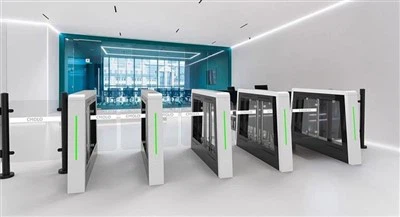
1. Technical Architecture: Moving from mechanical control to smart IoT
Traditional turnstiles use simple motor drives and sensors to detect people. They don't have much computational power or network communication modules, so they can't handle a lot of people at once. The rotary gate is based on smart IoT technology, and its main benefits are shown in three areas:
Real-time operating systems and processors with more than one core
Using an ARM architecture multi-core CPU that can accomplish jobs at the same time, like recognizing biometrics, checking permissions, and uploading data. The full-height turnstile, for example, can change its height every 0.8 seconds through the RTOS system. This lets it quickly open when it sees a valid entrance and immediately lock and sound an alarm when it sees an illegal entry. This closed-loop system of "perception decision execution" lets 2400 people per hour through a single channel, which is 100% more than the three roller gates that are usually used.
Array of sensors that work in multiple modes
It has 15 built-in sensors, including infrared radiation, microwave radar, and pressure sensing, that let it reliably detect the position, speed, and carrying status of walkers. During the Hangzhou Asian Games, the turnstile at one site employed pressure sensors to figure out how heavy the luggage was and automatically switched to a wide aisle option to stop luggage from getting stuck and causing traffic jams.
5G/Wi-Fi 6 communication module
Make sure that the ticketing system, security platform, and fire protection system can all connect to the cloud. The intelligent turnstiles at the Berlin Olympic Stadium, for example, have cut the time it takes to get in from 15 seconds per person to 2 seconds per person by exchanging data in real time. They have also cut the percentage of ticket fraud to 0.02%.
2. Functional feature: Move from single pass to complete scenario service
Through functional innovation, rotary turnstiles have changed admission management from "passive prevention and control" to "active service." Their main features are:
Technology for recognizing biometrics in more than one way
Support for facial identification, iris recognition, palm vein recognition, and more, with an accuracy rate of 99.99% and live detection to stop counterfeiting. During the 2025 European Championship, a certain venue will have "seamless passage" through facial recognition gates. This means that visitors will be able to verify their identity without having to produce their tickets or ID, and they will only need to wait for a short time. The line will be 60% shorter at busy times.
Changing the speed of traffic on the fly
Change the pace of the gate's rotation automatically based on how many people are passing through. For instance, Guangzhou Evergrande Football Stadium uses a "peak mode" during busy games, which speeds up the gate to 1.2 revolutions per second. During off-peak times, it switches to "energy-saving mode," which slows down the gate to 0.5 revolutions per second, balancing efficiency and energy use.
A device that warns people not to tailgate and keeps them safe
Using 15 ° anti-reverse technology to entirely stop reverse entry and adding metal detecting, security checks may be done at the same time as people pass through. At a big concert, the turnstile once saw controlled knives that people were carrying. This set off an alarm and locked the turnstile to keep people safe.
Managing passenger flow based on data
Collecting data in real time, such as admission time, age distribution, gender ratio, and more, to help make decisions about how to run the venue. For instance, a certain NBA venue changed the number of gate openings based on how long it took for people to get in, which cut the average wait time at busy times from 12 minutes to 3 minutes.
3. Adapting to the situation: Growth from general to specific
The entrances to sports venues are all different, and the turnstiles are made to fit each one perfectly through modular design:
Scenes from big events
In football fields that can hold more than 50,000 people, "wing gates + full height gates" are used. Wing gates let regular fans through at a rate of 40 people per minute. Full height gates are used for VIP areas and support "facial recognition + ticket verification" to make sure that only VIPs can get in and get special services.
Access for people with disabilities
Set up wider channels (at least 900mm wide) and a low-speed rotation mode. Make sure there is enough room in the rotating cabin for wheelchairs and strollers to get in and out. The turnstile at a certain Paralympic stadium uses pressure sensors to figure out how heavy the wheelchair is. It then immediately switches to broad aisle mode, which only takes 3 seconds to travel.
Scenario for emergency evacuation
The gate can immediately unlock and switch to two-way mode in case of an emergency, such a fire. It can also work with the navigation system to help people get out swiftly. During a practice drill, the turnstile at one musical venue cut the time it took to get people out from 8 minutes to 3 minutes.
Business operation scenario
Support interaction with payment platforms and membership systems to create "ticketing+consumption" integrated services. For instance, the turnstile at a high-end sports stadium has an NFC payment function that may automatically deduct points from a member's account or complete a payment for goods as the audience enters. This increases the rate of commercial conversion.
4. Management Efficiency: Changing from cost centers to value creators
Using turnstiles not only makes it easier to get in, but it also gives venues more value in many ways by giving them more data and making their processes more efficient.
Lower expenses of labor
Automated identification verification and anomalous behavior detection can cut the number of security guards by more than 30%. After turnstiles were put in at a certain Chinese Super League site, the security force went from 50 to 35 persons, which saved the team more than 2 million yuan a year in labor expenditures.
Making operations more efficient
Analyzing passenger movement data helps venues improve the structure of their retail and catering areas, which brings in 15% more money from sources other than ticket sales. For instance, one NBA venue moved the hot dog stand from the edge of the arena to near the entrance after looking at when people entered the venue. This led to a 25% boost in sales for a single game.
Risks to security that can be controlled
The real-time monitoring and warning system has cut the time it takes to find safety issues from minutes to seconds, which has cut the number of accidents by 40%. The turnstile at a big concert hall noticed that people were carrying flammable things and set up an alarm right away. It also connected to the fire protection system to keep big safety accidents from happening.
Increase in brand value
Intelligent entering experience makes people happier and gets 25% more positive ratings of the venue on social media. A certain football field had "3-second seamless passage" via turnstiles, which increased the number of people who bought tickets again by 18%. It became a benchmark for urban sports and culture.


WhatsApp : 0086-15999546575
Skype : cmolo.joy
Email : contact@cmolo.com
Tel : 0086-15999546575
CMOLO Industrial Park,NO. 144-1, Hengping Road,Henggang Street, Longgang District, Shenzhen City, China