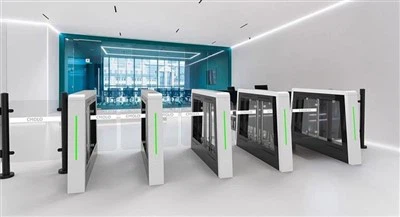
一,Technical adaptability: making sure that key operations and scene needs match exactly
1. Traffic efficiency: be able to handle a sudden surge of passengers
During the busiest times for big events, the flow of people through the gates can be hundreds of people per minute. The gates need to be able to respond quickly.
Wing gate: The gate wings open and close in less than 0.5 seconds, allowing traffic to flow in both directions and making it suited for regular audience channels. For instance, the Shanghai Xiaohongshu Night Walk in 2025 will have 20 wing gates and be able to handle 10,000 people each hour during peak hours. The average wait time for viewers will be less than 10 minutes.
Swing gate: The path may be up to 1.2 meters wide, which is plenty for big things like sports equipment, strollers, or wheelchairs to get through. This makes it a good choice for VIP entrances or passageways for special groups.
Three-roll gate: It's cheap and easy to build, thus it's good for places where people need to keep others from tailgating but don't need to move traffic quickly (such staff corridors).
2. Multimodal recognition: making verification more accurate and adaptable
To address the needs of different audience groups, large-scale events need to support more than one way to check credentials:
Recognizing identity cards and passports: Connect to the public security system to allow true name entry and security control. For instance, at the 2025 Mingguang Qunxing Concert, which had 12,000 attendees, 16 ID card flashing gates were utilized to catch 3 persons who weren't following the rules. This meant that no one was missed.
QR code and electronic ticket recognition: lets you scan tickets with your phone to get through quickly and lowers the cost of paper tickets.
Facial recognition: The recognition accuracy is 99.9% thanks to 3D structured light technology, which keeps photos and videos from being used to attack the system. This makes it good for high-end events or membership channels. For instance, the Shenzhen Cultural Expo, which has 8000 visitors, uses facial recognition gates to make it easier for guests to get in and give the event a more high-tech feel.
IC card/RFID: good for managing long-term access for personnel, reporters, and others.
3. Safety and Emergency: Setting Up Several Safety Systems
There is a considerable danger of safety at huge events, hence the gate needs to be able to do the following:
Anti-tailgating and anti-intrusion: The full-height rotary gate's enclosed design may impose "one person, one gate," and work with sensors to find people who are pushing on the gate illegally and set off alerts.
Power off and open the gate: automatically unlocked in case of an emergency to make sure people can get through. For instance, during a fire drill at an Olympic venue, the turnstile got 20,000 people out in only 1 minute and 20 seconds.
Design that doesn't pinch: By using both millimeter wave sensors and pressure sensing, you can properly find 0.1mm obstructions to avoid pinching the audience.
二,Requirements for the scenario: Tailor solutions to fit the size of the event and the type of venue.
1. Big sports arenas (with more than 50,000 people)
Pick a set of gates that are both stable and good at moving people through:
Main entrance: Use swing gates or wing gates to let thousands of people through every hour.
VIP/Media Channel: Using swing gates with facial recognition to quickly check identities and give out permissions.
Channel for staff: To save money and provide basic control needs, use three roller gates.
Emergency access: Full-height turnstiles make guarantee that people can only leave in one direction in an emergency.
2. Indoor sports arena for 10,000 to 50,000 persons
Need to find a balance between how space is used and how well traffic flows:
Design for narrow channels: Pick gates that are 60 cm wide or less to fit in small inside spaces.
Accessibility: Set aside a 1.2-meter-wide path for wheelchairs and strollers, with a disguised lifting platform.
Multi-channel collaboration: The central management system can change the times when the gate opens and closes to avoid traffic jams in the area.
3. Temporary construction areas, like open-air squares
Need to be able to be deployed quickly and adapt to different environments:
Modular design: The gate can be put together and taken apart quickly, making it great for temporary settings.
Choose IP65 level protective gear to keep you safe from harsh weather outside. It will keep water and dust out.
Mobile power support: comes with portable batteries that can be used to fix temporary power problems at a site.
三, Cost-effectiveness: Making decisions about leasing and buying that are fair
1. The cost of buying
Cost of equipment: A high-end rotary gate costs between 30,000 and 50,000 yuan, while a mid- to low-end model costs between 10,000 and 20,000 yuan.
Installation and upkeep: You have to pay for long-term storage, annual maintenance, and training for your staff.
2. Benefits of renting
Cheap and easy to use: The rental charge is between 500 and 1500 yuan per unit per day, and the equipment can be set up on demand to avoid being unused. For instance, renting 20 turnstiles for the 2025 Beijing International Auto Show, which can hold 15,000 people, will cost about 15,000 to 20,000 yuan for three days. This is 87% less than buying them.
Complete process service: The lessee does a site survey, installation, and commissioning, as well as on-site maintenance and emergency support, to make things easier for the organizer.
Iteration of technology: To improve the event's technological image, it may be best to use the newest tools, like gates that accept digital currency payments.
四, Guarantee of Service: Important Things to Look for in a Professional Rental Company
1. Strong technical skills
Support for numerous verification methods: Make sure the gate can work with more than one way to check identity, like an ID card, QR code, or facial recognition.
Ability to integrate with other systems: The gate must work smoothly with the event ticketing system and the public security platform so that data may be synced in real time.
Remote management function: Use a cloud platform to check the status of the gate, change access rights from afar, or fix problems.
2. Responding to an emergency
Backup equipment: The lessee must have enough backup turnstiles on hand so that they can be replaced within 15 minutes if they break down.
Support on site: Set up technical staff to be on site during the show to promptly fix problems like broken devices and network outages.
Plan for emergencies: Make sure you have specific plans for how to get out and recover from unexpected events like power outages and network assaults.
3. Cases and reputation
Experience in the field: To be sure they can handle big projects, give top priority to leasing businesses that have worked on significant events like the Olympics and the World Cup.
Customer review: Use industry recommendations, case studies, and other approaches to judge the lessee's service quality and speed of response.


WhatsApp : 0086-15999546575
Skype : cmolo.joy
Email : contact@cmolo.com
Tel : 0086-15999546575
CMOLO Industrial Park,NO. 144-1, Hengping Road,Henggang Street, Longgang District, Shenzhen City, China