1. Technical details: Hardware base for traffic capacity
The mechanical construction, motor system, sensor accuracy, and other hardware settings of a turnstile affect how much traffic it can handle. The following are its primary parameters, according to common product data in the industry:
Width of the channel and design of the structure
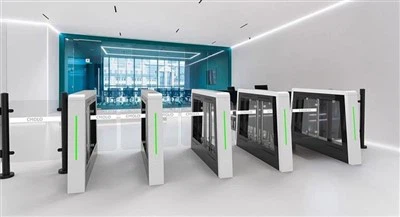
The full height turnstile channel is normally 600–800 mm wide, which is wide enough for one person to pass through. The structural design comes in two types: single door 90 degrees and double door 180 degrees. The double door 180 degree design makes the gate rod rotate more, which cuts down on the time it takes to reset after each passage and makes the passage more efficient. For instance, a certain type of full-height turnstile has a double door construction that opens 180 degrees and an automated reset feature that opens 120 degrees. The single channel passing speed can reach 25 people per minute.
Performance of the motor and drive system
The most common way to power rotary turnstiles is using a DC motor (50W/12V). The speed (1600 rpm) and torque of the motor directly affect the speed and stability of the gate rod. High-end products get the brake lever to turn evenly by improving the motor control algorithm. This stops delays in the passage caused by start-stop effects. For instance, the intelligent gate at one Olympic site can change the power of the motor to minimize the time it takes for the gate to open and close to 0.8 seconds. This makes traffic flow through a single channel 30% more efficiently.
Technology for sensors and recognition
Four or more pairs of infrared sensors and pressure sensing pads can tell if a single person is passing through, which stops tailgating and reverse intrusion. The integration of dynamic facial recognition technology (recognition speed<500ms, accuracy ≥ 99.7%) and RFID card readers in the ticketing verification process cuts the time it takes to verify a single ticket to less than 0.3 seconds. For instance, the gate system of a national fitness center can handle 30 persons per minute with dual-mode verification of "face+QR code."
2. Scene adaptation: changing the amount of traffic that can flow through it
The number of people that use sporting arenas changes over time, thus the turnstile needs to be able to change its function and mode to keep the flow of people balanced.
Managing traffic at peak hours
The gate system can make traffic flow better during the busiest times of event entry by doing the following:
Multi-channel collaboration: Change the number of open channels on the fly based on how many passengers are expected to flow through. For instance, one football field has a passenger flow prediction model built into its gate system. This increases the number of backup channels from 2 to 8 30 minutes in advance and the pass rate to 120 persons per minute.
Control of traffic in both directions: During the dispersal phase, the gate shifts to bidirectional traffic mode and LED lights show pedestrians which way to go. This innovation has cut the closing time of a big sports arena from 45 minutes to 15 minutes.
Sensorless passage technology: utilizing UWB ultra wideband location and millimeter wave radar to let the audience "pass" without stopping. A test study at one of the Winter Olympics venues demonstrated that the seamless access mode made a single channel 40% more efficient and cut the time it took to verify information by 70%.
Security control for special scenarios
Gates need to be both safe and efficient in certain situations, such when people need to leave quickly or when there is an outbreak:
Fire linkage mode: When the gate gets a fire alarm signal, it automatically unlocks the lever and stays open. The fire sprinkler system and the gate system in a given sports hall are linked so that the emergency exit is always clear.
Integration of health code verification: The gate can combine temperature detection and health code verification modules for public health events. The person in charge of a certain music festival used gate data to improve the layout of the dining area and bathroom, cutting down on the distance that people had to walk by 25%.
3. Efficiency optimization: always making traffic flow better
The traffic capacity of turnstiles can go from "hardware support" to "intelligent optimization" thanks to new technology and the integration of systems.
Digital Twin and Maintenance That Can Be Predicted
Make a virtual model of the gate, keep track of its functioning state in real time, and use AI algorithms to figure out how likely it is to break down. The operation and maintenance platform of a certain chain sports arena, for example, cut the failure rate of equipment by 60% and the cost of maintenance by 45% by looking at data like the temperature of the gate motor and the speed of the pole rotation. This helped keep the arena's traffic capacity from going down when equipment broke down.
Dynamic scheduling based on data
Make a heat map of passenger flow by recording things like when people enter, how long they stay, and which channel they choose. The basketball court's operating system looked at gate data and found that when the density of a given region went beyond a certain level, it immediately sent out a flow restriction alert and told the audience to go through the APP, which cut down on the area's congestion rate by 80%.
Design that can be broken down into parts and set up quickly
For temporary events, a modular gate design is used so that it may be set up and taken down quickly. For instance, a certain athletics world championship uses foldable turnstiles, which cut the time it takes to set up a single channel from 2 hours to 30 minutes. The turnstiles also work perfectly with the ticketing system because they have standardized interfaces.
4. Industry Practice: Examples and Data That Back It Up
Places for big events
A certain Olympic site uses an intelligent gate system that combines facial recognition, ticket verification, health code verification, and other features. The single channel traffic efficiency reaches 35 passengers per minute, and it cuts down on scalping by 85% and ticket disputes by 90%.
Fitness Center of the United States
A certain national fitness center has made it easy to connect online and offline by using a gate system. A WeChat micro program lets people buy tickets and choose their seats ahead of time. The time it takes to check in at the gate has been cut down to 0.5 seconds per individual, and the time it takes to get in line has been cut down from 30 minutes to 5 minutes.
Field for professional football
A certain professional football field has a passenger flow prediction model built into its gate system. It changes the channel layout based on past data and raises the pass rate to 150 persons per minute at busy times. The anti-tailgating feature also cuts down on unauthorized intrusions by 92%.


WhatsApp : 0086-15999546575
Skype : cmolo.joy
Email : contact@cmolo.com
Tel : 0086-15999546575
CMOLO Industrial Park,NO. 144-1, Hengping Road,Henggang Street, Longgang District, Shenzhen City, China