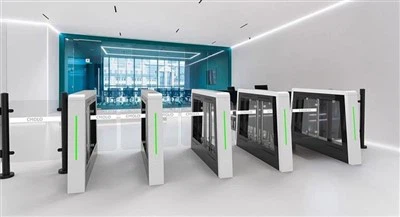
1, Technical architecture: Layered design for precise control
The modern turnstile adopts a three-tier architecture of "front-end awareness - edge computing - cloud management", and realizes identity differentiation through in-depth collaboration of hardware and software:
Front end perception layer
Integrate multimodal biometric modules (3D facial recognition, palm vein recognition, fingerprint recognition), radio frequency identification (RFID/NFC), QR code scanners, and other devices. For example, the Shenzhen Tiejun intelligent full height turnstile adopts binocular cameras and liveness detection algorithm, which can complete facial recognition and temperature detection within 0.3 seconds. It also supports multimedia verification such as ID card, health code, membership card, etc., providing differentiated verification methods for different identity groups.
Edge computing layer
Built in high-performance AI chips (such as NVIDIA Jetson series) enable localized decision-making. When employees "brush their faces" to pass, the edge computing unit can quickly compare with the local database (store the white list of employees), and can complete permission verification without relying on the cloud server, with a response time of less than 200ms. The gateway system deployed by Shanghai K11 Shopping Arts Center optimizes the data upload frequency to once/5 seconds through the edge computing gateway, reducing the bandwidth occupation by 80%, while ensuring real-time performance.
Cloud management layer
Based on a distributed cloud platform architecture, it supports centralized management of multiple branches. Enterprises can dynamically adjust permission rules through the management backend (such as temporarily opening employee channels for customers to visit), and generate visual reports (employee attendance statistics, customer flow heatmap). The hybrid cloud architecture adopted by Beijing SKP Mall reduces data storage costs by 40% while meeting the Level 3 security requirements of Equal Protection 2.0.
2, Identity recognition: Multi technology integration to solve the problem of differentiation
The cutting-edge turnstile achieves high-precision differentiation between employees and customers through a triple verification system of "biometric+physical credentials+behavioral patterns":
Unique binding of biometric features
The employee channel generally adopts 3D structured light facial recognition technology, combined with liveness detection algorithms (such as infrared binocular cameras), which can resist forgery attacks such as photos, videos, masks, etc., with a recognition accuracy of over 99.9%. The customer channel is mainly based on QR codes/NFCs, and dynamic tokens (refreshed every minute) are used to prevent ticket theft. The turnstiles in the security checkpoint of Guangzhou Baiyun Airport are dynamically monitored within a 20 meter range using a 77GHz millimeter wave radar, which can accurately record the passage time even if customers carry suitcases.
Differentiated design of physical credentials
Employees are usually equipped with encrypted RFID tags (storing unique IDs and department information), while customers use temporary QR codes or membership cards. The gate system used in Shenzhen Wanda Plaza naturally guides the flow of two types of people through physical isolation design (employee channel width 60cm, customer channel 90cm) and visual guidance (ground LED arrow indication).
Deep learning of behavioral patterns
The millimeter wave radar and pressure sensor built into the gate can collect data such as traffic speed and gait characteristics. By training the model with LSTM neural network, the system can recognize abnormal behaviors (such as customer wandering in the employee channel or multiple people following in the customer channel). The gate system used in Chengdu Taikoo Li Convenience Store has a behavior recognition accuracy rate of 98.6% and a false alarm rate of less than 0.5%.
3, Permission Management: Dynamic Rule Engine Adapts to Complex Scenarios
The cutting-edge rotary gate achieves the following core functions through a configurable permission rule engine:
Time dimension permission control
Employee permissions can be linked to attendance periods (such as the R&D department only allowing access from 9:00-18:00), while customer channels are fully open during business hours. The gate system of Hangzhou Intime Department Store achieves dynamic permission adjustment through the Flink flow computing framework - when the mall holds night promotions, the system automatically extends the customer channel opening time to 22:30.
Classification of spatial dimension permissions
Large scale parks adopt a multi-level permission system: ordinary employees can only access the office area, executives can enter the data center, and visitors need to pass through temporary passages accompanied by security guards. The gate system customized by Shenzhen Hongshun Meng Company for a certain prison uses the national security SM4 encryption module to achieve "one machine, one password" access data, preventing internal information leakage.
Dynamic allocation of temporary permissions
For temporary personnel such as food delivery and equipment maintenance, the system supports generating time limited QR codes (valid for 2 hours) or NFC tags through the management backend. The entrance gate network of Shanghai Disneyland uses blockchain technology to store temporary permissions that cannot be tampered with, ensuring security and controllability.
4, Scenario adaptation: differentiated solutions from commercial complexes to industrial parks
There are significant differences in the requirements for turnstiles in different scenarios, and targeted optimization of technical parameters is needed:
Commercial complex: peak traffic carrying capacity
Taking Shenzhen Coastal City Shopping Center as an example, its deployed gate system needs to meet the daily traffic demand of 200000 people on weekends. Efficient diversion can be achieved through the following design:
Parallel channel design: Employee channel (facial recognition) and customer channel (QR code scanning) are configured in a 1:5 ratio
Predictive gate opening: Train a passenger flow prediction model using historical data and open the gate 10 seconds in advance during peak hours
Abnormal traffic circuit breaker: When the number of people passing through a single channel exceeds the threshold, it automatically switches to manual mode and triggers an alarm
Industrial Park: Enhanced Safety Protection
The gate system of a certain automobile manufacturing factory needs to meet industrial grade requirements such as explosion-proof, dustproof, and impact resistance:
Mechanical structure: Made of 304 stainless steel body and explosion-proof glass, capable of withstanding an impact force of 50kg without damage
Environmental adaptability: IP65 protection level supports wide temperature operation from -20 ℃ to 60 ℃, equipped with automatic heating and defrosting function
Security linkage: Integrate with the fire protection system, automatically unlock all gates and push alarm information to the security center in case of a fire
Transportation Hub: Multi technology Integration Verification
The intelligent gate system adopted by Beijing Daxing Airport integrates the following technologies to achieve rapid passenger diversion:
Multi spectral facial recognition: maintains 99.7% recognition rate in backlit and strong light environments
Luggage synchronization detection: using millimeter wave radar to determine whether passengers are carrying oversized luggage and guiding them to manual channels
Sensorless payment integration: integration with airline systems to achieve full process automation of "face recognition check-in payment"
Tripod Turnstile Gate


WhatsApp : 0086-15999546575
Skype : cmolo.joy
Email : contact@cmolo.com
Tel : 0086-15999546575
CMOLO Industrial Park,NO. 144-1, Hengping Road,Henggang Street, Longgang District, Shenzhen City, China