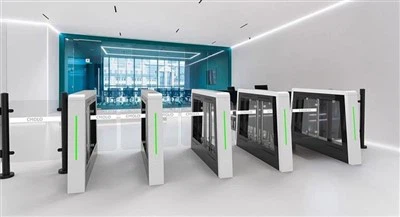
1. Physical Protection: Making a channel barrier that can't be broken
The main idea behind the turnstile's design comes from its dynamic, contained structure, which uses mechanical locking and spatial isolation to protect against theft. For example, a full-height rotational gate can be 2.2 meters tall and have a rotation angle of 120 ° or 90 °. This makes a continuous physical barrier that totally stops anybody from climbing or drilling through it. A particular chain supermarket's test data shows that after installing full-height turnstiles, the theft rate of items at the entrance dropped by 67%. This is far better than the prevention and control effect of standard three-roller turnstiles (32%) and wing turnstiles (45%).
The rotary brake is very reliable mechanically. It has a hydraulic shock absorber core and a stainless steel rainproof box. It can work in a wide range of temperatures, from -20 °C to 60 °C, and has an IP45 protection rating. The SA101 series from Shenzhen Zhimei Intelligent Technology Co., Ltd. is a good example. Its movement is noise-free thanks to ARM control technology, and it can last for over 10 million cycles and handle a daily traffic level of 5000 people. This industrial-grade design makes sure that the gate works all the time and is stable even when there is a lot of traffic in supermarkets. This keeps the gate from breaking down and causing security holes.
2. Smart perception: getting the right identification of risky behaviors
Turnstiles have gone from being passive protection to active warning with an intelligent upgrade. A behavior analysis model is built using a multimodal sensor array.
Anti tailgating system: It has 12 sets of infrared sensors and millimeter wave radar built in, which lets it accurately track the number, travel path, and body shape of people in the channel. The gate locks the gate rod and sets off an audio and visual warning when it sees two individuals passing through or entering in reverse. It also sends coordinate data to the monitoring system. A real test at a big supermarket reveals that this technique cuts the missed reporting rate of trailing events from 12% to 0.3% and speeds up processing by 60%.
Module for controlling permissions: It works with the supermarket membership system and supports a variety of authentication techniques, including IC/ID cards, QR codes, and facial recognition. The Sichuang EAS+RFID dual frequency loss prevention system, for instance, uses electromagnetic rotation unlocking technology to let only purchased products through the gate. If a non-demagnetized item tries to pass through, an alert will go out and the channel will be locked. Using this plan in a clothes business cut the likelihood of cashiers stealing by 82%.
Watching for strange behavior: Some high-end models come with behavior analysis cameras that can spot strange behaviors like wandering and squatting. When the system thinks there is a chance of theft, it automatically gets video from nearby cameras to double-check and sends warning information to the mobile devices of security staff. The pilot study of an international supermarket demonstrates that this feature has made it 54% more likely to catch pickpockets and cut the average response time to 8 seconds.
3. Giving data power: The Smart Hub Making decisions about how to run things
As the front-end node for collecting supermarket data, the turnstile connects its traffic record and monitoring system, POS system, and passenger flow analytic platform to create a digital closed loop for preventing theft and loss:
Heat study of passenger flow: You may make a mall heat map by monitoring the times and frequencies of people entering and leaving through the gate, along with Wi Fi probes and video analysis. The use of a smart supermarket has proven that this technology can accurately find high-risk locations (such jewelry and fresh food sections), let security resources be used more effectively, and cut theft rates in crucial areas by 41%.
Prediction of loss mode: Use past data to teach a machine learning model to guess when and where merchandise theft will happen the most. For instance, a certain chain supermarket looked at the gate traffic data and inventory system and observed that the loss rate in the fresh food section went up every Friday night in a strange way. The loss rate went down by 29% after they strengthened targeted patrols during this time.
Optimizing emergency response: When the fire alarm goes off, the gate unlocks and stays open. This is because it is connected to the fire alarm system. The monitoring technology also makes an evacuation heat map to help people stay away from unsafe locations. The fire drill at a big grocery store showed that the linkage plan cut the time it took to evacuate from 8 minutes to 3.5 minutes, which is in line with the "Code for Fire Protection Design of Buildings" rules for emergency evacuation. 4. Industry Practice: From Standard Solutions to Landscape Innovation
To meet the security needs of different locations in supermarkets, rotary turnstiles have come up with a number of alternative solutions:
Channel for the main entrance: Put in full-height cross turnstiles that have anti-tailgating, anti-climbing, and permission control features. These will be the first line of defense. A weight sensor was put at the entrance gate of a community supermarket. When a child walks through alone, it automatically sends voice reminders and tells parents, which cuts down on lost children by 90%.
Employee access: Using half-height turnstiles and fingerprint recognition modules to carefully limit who can enter the building. Through this method, a certain chain store found and dealt with 17 internal infractions, recovering more than 500,000 yuan in lost business.
Self-service checkout area: has a spinning gate with an RFID card reader that connects to the self-service checkout system. The gate will unlock automatically after the consumer pays. If there are any outstanding items, the gate will lock and the police will be called right away. This plan cut the loss rate in the self-service checkout area of a big supermarket from 1.2% to 0.3% in a test trial.


WhatsApp : 0086-15999546575
Skype : cmolo.joy
Email : contact@cmolo.com
Tel : 0086-15999546575
CMOLO Industrial Park,NO. 144-1, Hengping Road,Henggang Street, Longgang District, Shenzhen City, China