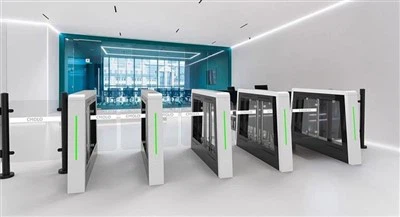
1, Factors affecting passengers' waiting time at turnstiles
Passenger traffic speed will depend on the recognition verification period and the wing door of the turnstile's rotation speed. Should the wing door rotate slowly or the identification verification process be labor-intensive, passenger passing through the gate will have more time, hence increasing waiting times.
Should the turnstile fail during operation-that is, in cases of wing door jamming, sensor failure, etc.-it will be unable to operate as intended, thus passengers will have to wait for maintenance staff to handle or bypass other turnstiles, so augmenting the total waiting time.
Some passengers may not be familiar with the use of turnstiles, such as not knowing how to correctly place tickets, swipe cards, or perform biometric verification, thereby causing extended stays in front of the turnstile.
Problem carrying objects: When passing through turnstiles, individuals carrying bulky bags, strollers, or those with limited mobility need additional time and space; this can readily produce traffic at the gate and influence the flow of other passengers.
Matching degree between passenger flow and number of gates
Peak period of passenger flow will be much higher during holidays, major events, or busy commuting times. Long waiting times for passengers will follow from inadequate turnstile count to satisfy the travel needs of many people.
Unreasonable turnstile layout: The efficiency of passenger passage and waiting time will suffer if the turnstile layout is not reasonable, say narrow passageways or too tiny distances between them.
2, Reduce waiting time by optimizing the design of rotary turnstiles
Boost traffic velocity
Improve wing door design. Use lightweight materials and more sophisticated driving technologies to increase wing door rotation speed and sensitivity. Wing doors may be opened and closed quickly, hence lowering passenger waiting time, by using high-performance motors and reducers.
Simplify the procedure of recognition and verification. Install quick and accurate recognition technologies such QR code scanning, facial recognition, etc., to cut passenger verification procedure time consumption. Simultaneously, maximize the verification algorithm to raise the recognition success rate and prevent repeated operations brought about by verification failures.
Enhance device stability
choosing first-rate parts: Reliable and steady parts like sensors and controllers are chosen for rotary turnstile manufacture to lower equipment failure rates. Regularly check and maintain parts; quickly spot and replace old or broken ones.
Enhance self- diagnostic and fault warning systems. Equip rotary turnstiles with sophisticated fault warning and self-diagnosing systems that can track the running state of the equipment in real time, identify any fault threats ahead of time, and quickly produce alarms. Simultaneously, the system can cut the time for fault management, instantly identify the origin of problems, and offer accurate maintenance advice for maintenance staff.
Optimize gate layout and channel design
Based on the expected passenger flow and traffic demand of the venue, fairly decide the number and installation site of turnstiles. Increase the number of turnstiles suitably in places with plenty of people to prevent congestion. Simultaneously, considering passenger traveling paths and habits, the gate design should be more logical and practical.
Increasing the channel width: The turnstile's width should be suitably expanded to give enough passage room for passengers who might have big bags or impaired mobility. On both sides of the passage, set up unambiguous signage and guiding lines to enable guests pass through the gate fast and orderly.
3, Reduce waiting time by improving technical proficiency
Intelligent scheduling and management system
Real-time observation of passenger flow: Real-time monitoring the passenger flow and passing at the turnstile using sensors, cameras, and other equipment. Data analysis helps us to understand changing passenger flow trends and provide a foundation for turnstile scheduling and management.
Turnstile operating state should be dynamically changed: Real-time passenger flow data allows the intelligent scheduling and management system to automatically change the turnstile's operational condition. Increasing the number of gate openings, for instance, can help traffic flow during peak times; lowering the number of gate openings will help traffic flow during low passenger flow and hence save energy consumption.
Multi mode traffic technology
Multiple recognition techniques integration: To satisfy the needs of various passengers, several recognition techniques-card swiping, QR code scanning, facial recognition, fingerprint recognition, etc.-are combined on the turnstile. To increase journey speed, passengers can choose the most practical identification technique depending on their real circumstances.
Combining online verification with offline recognition: Using a solution combining offline recognition and online verification helps one to handle unanticipated events including network disruptions. In case of network failure, the gate can first perform offline identification to let passengers pass through, then perform data synchronization and verification after the network is restored; when the network is normal, the passenger's identification information is uploaded in real-time to the server for verification.
Linkage with external systems
Linkage with the ticketing system: after ticket purchase, travelers can quickly send pertinent information to the turnstiles, therefore enabling perfect integration between turnstiles and ticketing system. The gate can rapidly scan tickets information and validate it when people pass through it, therefore lowering the verification time.
Relation to the security system: Linking the turnstile with the security system, an alert can be triggered promptly and related actions can be done should unusual behavior or suspicious individuals be identified. Simultaneously, guarantee safety and streamline the security screening procedure to prevent unnecessarily long passenger waiting times resulting from too thorough inspections.
4, Reduce waiting time by improving management strategies
Around the turnstile, set up clear, striking guiding signs comprising directions of passage, identification instructions, safety considerations, etc., so enabling passengers to rapidly learn how to use the turnstile and so minimize waiting time resulting from unskilled operation.
Organize passenger education initiatives: Using promotional posters, video tutorials, on-site demonstrations, and other strategies, teach travellers turnstile use. Particularly in areas where new equipment is used or where passenger traffic is high, expand coaching and training for consumers to increase their travel efficiency.
Reasonably set staff members' configurations. At the turnstile, equip enough personnel to assist in passenger guidance, question answering, handling of crises, etc. Staff members should be able to quickly address passenger difficulties they come across during gate pass and possess good service awareness and emergency reaction skills.
Create backup strategies. Create thorough emergency plans covering possible failures, abrupt passenger flow surges, and other unanticipated events. Frequent staff emergency exercises help to increase their capacity to react to unanticipated occurrences, guarantee that actions can be conducted fast and successfully in an emergency, and therefore lower passenger waiting times.
Create a passenger flow predicting model. Create a passenger flow prediction model by means of historical data and sophisticated analysis techniques to precisely forecast passenger flow over several timeframes. Make prior plans for the staffing and scheduling of the turnstiles based on the prediction findings to guarantee that the passenger traffic needs can be satisfied during high passenger flow.
Using diversion policies: Diversion techniques are used to lead passengers to other more inactive gates or passageways when the passenger flow is too strong. For instance, travelers can be instantly notified of the traffic status at every gate via broadcasting, electronic displays, and other means, so leading them to take a sensible path.
Bi-Directional High Glass Half Height Turnstile


WhatsApp : 0086-15999546575
Skype : cmolo.joy
Email : contact@cmolo.com
Tel : 0086-15999546575
CMOLO Industrial Park,NO. 144-1, Hengping Road,Henggang Street, Longgang District, Shenzhen City, China