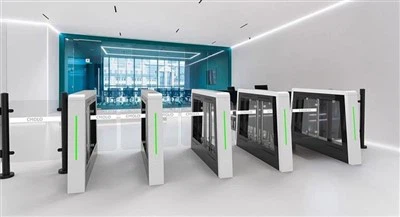
1, Analysis of Pain Points in Traditional Rotary Gate Interaction
Unidirectional visual reference: Conventional turnstiles simply show traffic status using indicator light colors (red/green), and under high light conditions the identification rate decreases to 75%.
Lack of barrier free interaction: visually challenged people depend on manual guiding and cannot get access information through visual signals.
Regular inaccurate operations: Only the buzzer sounds an alert without particular direction when not carrying a ticket or making operational mistakes.
Congestion in peak hours: Conventional turnstiles without voice instruction cause a 30% prolongation of queuing time.
Needs for multilingualism: Lack of multilingual help in international hub situations causes 40% of foreign visitors to be confused.
Traditional turnstiles just employ flashing lights to indicate in case of fire or another disaster, therefore lowering the efficiency of evacuation by half.
2, Implementation of Dual Modal Interaction System Technology
Multi-scenerial voice library:
Create simple instruction manuals including "please pass" and "please swipe card".
Create a custom scenario library including "Student ticket verified" and "If the luggage is too large, please use manual channels".
Support eight language real-time switching including Chinese, English, and Japanese.
Clever voice engine:
Synthesize a naturalness MOS score of ≥ 4.2 with TTS (Text to Speech) technology.
Implement a noise- suppressing system in an 85dB environment with voice recognition accuracy of 98%.
Support offline mode operation; pre-stored voice can still be played even in the case of network disconnection
Technology based on directional sound fields:
achieving 15 ° exact sound beam projection using parametric array speakers
Speech Clarity Index (STI) > 0.85 to prevent interference with neighboring channels
Multimodal display screen:
Integrated ten-1-inch IPS LCD screen with 1920 x 1200 resolution
Support dynamic QR code display running 60Hz refresh rate.
Possessed an ambient light sensor, automatically change the screen brightness (50–1000cd/m ²).
System of status indications:
Traffic status: allowed/red cross (prohibited) green arrow
Student tickets (yellow green dual color), senior citizen tickets (purple), ordinary ticket (green)
E101, sensor failure; E203, motor overload; etc., fault codes
Designed with accessibility: adaptability
Wheelchair users can change the screen height (1.2–1.8 m) to fit their viewing angle.
furnished with Braille signs timed with spoken cues
Contrast ratio at least 15:1, compatible with WCAG 2.1 AA criterion
Mechanism of state consciousness:
Millimeter wave radar's people distance detection accuracy ± 5 cm
Wake the interactive system automatically when the user falls inside the 1.5-meter range.
Strategy of multimodal linking:
Good card swipe: Voice "Welcome" + green arrow + screen showing "Verified".
Voice message "Illegal passage, please retreat" + red cross + sound and light warning.
Voice "device maintenance in progress" + screen showing fault code + advice for manual channel fault status
Individualized environments:
Support range of 0 to 100dB for volume modification
One can disable specific voice prompts (like "please maintain spacing ").
Offer silent mode-visual cue only.
3, Typical scenario application practice
Subway hub scene
Technical resolution:
Install dual-mode turnstiles with 1100mm of a channel width.
Combine peak hour diversion speech ("Please swipe your face on the left channel, scan the code on the right channel").
Development discount ticket verifying ("Student tickets have been verified, wish you a smooth academic journey")
Implementing impact:
42% raise in traffic flow efficiency
Illegal activity now accounts for 0.3% instead.
For those with visual disabilities, independent passage's success rate comes at 95%.
Scene of an airport
Innovative Approach:
Choosing full height rotary turnstiles with anti-clustering voice warnings
Create visual cues for luggage size identification (screen shows' luggage exceeds limit, kindly utilize manual channel "").
Link with the flight information system, audio announcement of boarding gate adjustments ("Please note that CA1883 boarding gate has been changed to B20").
Operational records:
60% less questions asked by passengers
Channel occupancy time dropped 35%.
50% faster response speed for unique service demands
Smart community scenarios
intelligent approach:
Install facial recognition turnstiles and voice broadcast residents' names ("Welcome home, Mr. Zhang").
Create a guest reservation system including a speech and screen presentation of visitor data ("Your visitor Ms. Li has arrived").
With an emergency broadcast interface and voice guidance for a fire ("Please evacuate quickly from the left channel")
Advantages in energy savings:
From 5.2 kWh to 3.5 kWh a single machine's daily average power consumption has dropped.
Cut maintenance by 45%
Residents' level of satisfaction has risen to 98%.
Smarter High Glass Security Turnstiles


WhatsApp : 0086-15999546575
Skype : cmolo.joy
Email : contact@cmolo.com
Tel : 0086-15999546575
CMOLO Industrial Park,NO. 144-1, Hengping Road,Henggang Street, Longgang District, Shenzhen City, China