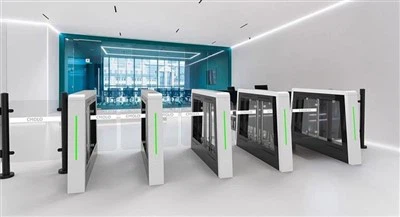
一,Security control: building a protection system with many layers
Turnstiles in sporting stadiums are mostly used for safety and security because they are crowded places. It builds a "hardware+software" protection system with multiple layers by using physical separation and smart recognition technologies.
1. Detection of reverse intrusion and anti-tailgating
Modern turnstiles use both infrared sensors and pressure sensing pads to reliably tell if a single person is passing through. When more than one person is seen going through or entering in reverse, the gate will automatically lock the lever and set off an alarm. An intelligent gate at one Olympic site uses 16 sets of infrared sensors to create a 3D detection grid. This makes tailgating recognition 99.8% more accurate and stops unauthorized people from getting in.
2. Design that stops climbing and drilling
The gate switch rod is composed of solid stainless steel and has a diameter of at least 80mm. The spacing is tightly managed to be within 600mm, which is in line with international safety regulations. Put up anti-drilling barriers at the bottom that make a 15° angle with the ground. This will make it impossible for the structure to tip over. After improving the gate system, there were 92% fewer unlawful entries at a certain football stadium, and security personnel costs went down by 40%.
3. Quickly responding to an emergency evacuation
In an emergency, turnstiles should be able to flip between peacetime and wartime. The gate may automatically unlock the lever within 0.5 seconds after getting the fire linkage signal, making a way to get through. The BIM building model is connected to the gate system of a major sports arena. In event of an emergency, the BIM model can automatically design the best way to get people out and use the gate LED indication lights to direct the flow of people.
二,Ticket management: getting complete digital control of the process
The ticketing system for sporting arenas needs to be able to manage several sorts of tickets, like pre-purchased tickets, on-site tickets, annual passes, membership cards, and more. The turnstile uses a combination of different verification methods to create an intelligent ticketing management loop:
1. Checking tickets in more than one way
Allow for more than one way to prove your identity, like QR codes, RFID chips, NFC (near-field communication), biometric recognition (facial or fingerprint), and more. The gate system at a certain NBA facility can read the RFID chips in both mobile electronic tickets and physical tickets at the same time. It takes 0.3 seconds per person to verify a ticket, and at peak hours, the pass rate has gone up to 120 people per minute.
2. Measures to stop counterfeiting and reuse
Using dynamic encryption technology and a one-time verification code system to make sure that each ticket is unique. The gate and ticketing system are always in sync, and tickets that have already been used are automatically void. This system has cut down on scalping by 85% and ticket disputes by 90% at one concert venue.
3. Managing permissions and memberships
The gate can include a permit recognition module for particular sections like VIP channels, media areas, and athlete channels. By connecting to the venue's CRM system, you can have complete control over membership levels, ticket types, and access rights. A certain golf club has witnessed a 30% rise in member service satisfaction since they switched to a graded gate system.
三, Optimizing crowd flow: making the venue run more smoothly
Sports arenas have clear patterns in the flow of people over time. The turnstile uses smart scheduling algorithms to keep the flow of people balanced:
1. Managing channels in a dynamic way
The gate system may automatically change the number of open channels based on real-time data on the flow of passengers. During the busiest time for admissions, the backup channels were increased from 2 to 8, which led to a 300% rise in the pass rate. This feature has cut the wait time for spectators at a given Olympic location from 45 minutes to 8 minutes.
2. Control of traffic in both directions
During the closing phase, the gate can transition to a two-way traffic mode and use LED lights to show people where to go. A certain football field has a passenger flow prediction model built into the gate system. This model predicts the pressure of the end game 30 minutes ahead of time and changes the channel layout on the fly to minimize traffic jams.
3. Design for easy access
Make sure that persons with disabilities and pregnant women have their own paths to follow. The width of the gate lever can be increased to 1200mm, which makes it easier for wheelchairs to get through. The ADA-compliant barrier-free gate at a big sports arena has voice prompts and low-position operating panels.
四, Data collection: making smart decisions on how to run the business
The turnstile is the "data entrance" to the venue. It may collect operational data from several angles and help managers make better decisions.
1. Keeping an eye on the movement of passengers in real time
Counting the number of people coming in and out of the gate in real time with the counting sensor, which makes a heat map of passenger flow. The operating system of a given basketball court can show how many people are in each location in real time. It can also automatically send out a flow restriction alert when the number of people in a certain region goes beyond a certain level.
2. Analyzing behavior patterns
To construct user profiles, keep track of things like when people enter, how long they stay, which channel they choose, and other behavior data. By looking at gate data, the person in charge of a music festival modified the dining area and washroom layout better, cutting down on how far people had to go by 25%.
3. Keeping track of the health of your equipment
Keep an eye on things like the temperature of the gate motor, the speed of the spinning rod, the status of the sensor, and so on, and guess when maintenance will be needed. By looking at gate operating data, the operation and maintenance platform of a certain chain sports center cut the rate of equipment failure by 60% and maintenance expenses by 45%.
五, Emergency response: Making a safety net
The turnstile needs to swiftly convert to emergency management mode in case of an emergency and connect to the venue's security system:
1. Control of fire links
When the fire alarm goes off, the gate automatically unlocks the lever and stays open. It also sends the security center information about where it is. The fire sprinkler system and the gate system in a given sports hall are connected so that the emergency exit is always clear.
2. Mode for stopping riots and terrorism
If there is a violent collision, the gate can go into enhanced mode. The revolving rod locks itself and sounds an alert while sending the location to the security system. The gate of a big arena is designed to be explosion-proof, so it can take a hit of 500 kg without breaking.
3. Help with controlling epidemics
In public health emergencies, turnstiles can have modules that check temperatures and health codes. The gate system at one Winter Olympics location has become a three-in-one system that can measure temperature, check codes, and check tickets. It can pass 80 people per minute through a single channel and cut down on the need for manual verification by 70%.


WhatsApp : 0086-15999546575
Skype : cmolo.joy
Email : contact@cmolo.com
Tel : 0086-15999546575
CMOLO Industrial Park,NO. 144-1, Hengping Road,Henggang Street, Longgang District, Shenzhen City, China