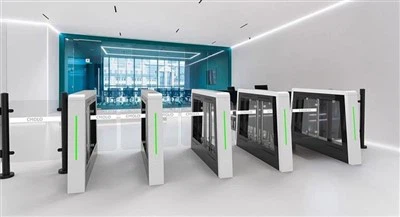
1. Security Control: Moving from "Passive Defense" to "Active Warning"
Sports venues are crowded areas that can be dangerous at any time throughout an event. Traditional turnstiles can only do basic interception tasks. On the other hand, modern rotating turnstiles use a combination of different types of sensors and AI algorithms to create a three-dimensional security system.
Stopping somebody from following you and breaking in
The full-height turnstile's enclosed rotating cabin design demands "one person, one gate" to keep unauthorized people from coming in. For instance, some international soccer fields have turnstiles with sensors that stop collisions. When someone pushes the gate in an illegal way, the turnstile will lock right away and sound an alarm. At the same time, the security system will be linked to find the risk point, which will cut the time it takes to respond to a safety issue to three seconds.
Checking someone's identity and giving them permission
The high-tech turnstile can check "facial recognition+ticketing system+health code" three times, which lets it tell the difference between different permitted groups including the crowd, staff, VIPs, and journalists. For example, at one Olympic venue, the turnstiles are connected to the event management system to offer "face recognition entry+seat navigation" services. This stops scalpers from selling tickets and also stops fans from accidentally accessing restricted zones.
Design for emergency evacuation and fighting terrorism
In an emergency, the turnstile can automatically switch to "power-off opening" mode so that people can pass through without any problems. Some high-end models additionally have explosion-proof glass, secret escape buttons, and remote control functions that meet anti-terrorism safety regulations. For instance, during a fake fire drill at an NBA facility, the turnstile was able to get 20,000 people out in just one minute and twenty seconds, which was 40% faster than regular turnstiles.
2. Traffic efficiency: a change from "artificial bottleneck" to "intelligent diversion"
One hour before the start of the event is usually when the most people are at sports stadiums. Traditional ways of checking tickets can easily cause entrance congestion. The new rotary gate lets people past quickly thanks to the following technologies:
Collaboration across multiple channels and scheduling that changes over time
Using algorithms, the central management system can keep an eye on the flow density of people in each channel in real time and change the state of the gate opening and closing. For instance, a fleet of 32 turnstiles at a big music venue sped up the flow of people from 30 to 80 persons per minute during peak admission hours, cutting the length of the line by 75%.
Integration of multiple payments and sensorless passage
Supports a number of payment options, including NFC, QR codes, biometric recognition, and digital currency. This lets people pass through swiftly without pausing. The turnstile at a certain European football league arena has a "contactless ticket verification+temperature detection" feature. It takes only 0.8 seconds to go through one channel, which is three times faster than regular turnstiles.
Adapting luggage and particular groups
For people who are bringing sports equipment, strollers, or wheelchairs into sporting venues, the new turnstiles have large openings (up to 1.2 meters) and are easy to use. For instance, the turnstile at one Paralympic venue has a lifting platform that makes it easier for those with impairments to get through on their own. This shows that the venue cares about people.
3. Operational optimization: going from "data silos" to "smart decision-making"
Rotary turnstiles are not only pieces of hardware; they are also the "data entry point" for how sports stadiums work digitally. The cutting-edge solution can help managers by gathering information including traffic logs, consumer behavior, and device status.
Creating heat maps and analyzing passenger flow
The central platform can keep track of how many people visit each section and at each time, make a heat map of passenger traffic, and help improve security, sales, and toilet layout. A CBA venue looked at gate data and saw that the number of people coming in through the south door rose sharply during the third interval. Based on this, the number of drink stalls in the area was changed, which led to a 15% rise in sales at the same location.
Maintenance that is based on predictions
Functions like monitoring motor current and analyzing encoder accuracy might help you find gate problems before they happen. For instance, the turnstile at a certain Winter Olympics venue uses a vibration sensor to find a problem with a certain channel motor. The system then automatically sends a maintenance work order to keep the equipment from going down during the event.
Mining for commercial value
For accurate marketing, gate data can be combined with membership systems and advertising platforms. A certain English Premier League team set up individualized product recommendation screens near the gate by looking at when people entered and how they used the products. This led to a 22% rise in sales of peripheral products.
4. User Experience: Moving from "Mechanical Interception" to "Service Extension"
The modern rotary gate has improved its basic traffic function by adding a service entry through thoughtful design.
Voice coaching and interaction in more than one language
It supports more than ten languages, including Chinese, English, and Japanese. It also uses audio prompts to help the audience with ticket verification, security checks, and other tasks. At a certain F1 race location, the turnstile has a race information display screen that shows real-time information like the weather on the track and the rankings of the drivers as people pass through.
Services for members and redeeming points
The gate can instantly add points to a member's account after they connect with the venue app. For instance, when you enter a certain NBA venue, the turnstile gives you a "check-in task" to do. When you finish the task, you can trade it in for a signed jersey or the chance to buy a ticket first.
Brand Communication and Cultural Display
You can make the gate shell into a team logo, the color of the event's theme, or an ad for a sponsor. It will then become a part of the venue's image. At night, the turnstile at a certain World Cup venue switched on its LED light show, which made people want to take pictures and share them. The connected issue was seen on social media more than 5 million times.


WhatsApp : 0086-15999546575
Skype : cmolo.joy
Email : contact@cmolo.com
Tel : 0086-15999546575
CMOLO Industrial Park,NO. 144-1, Hengping Road,Henggang Street, Longgang District, Shenzhen City, China