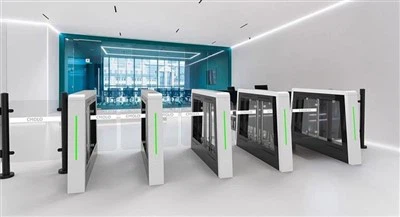
1, Definition and classification of rotary gates
A revolving gate, also known as a revolving door or turnstile, is an access control device that controls the entry and exit of personnel through a rotating mechanism. It is usually composed of multiple metal poles or fences, forming a rotatable passage. When personnel pass through, the metal poles or fences will rotate accordingly, allowing or preventing passage. According to different application scenarios and functions, rotary gates can be divided into various types, such as full height rotary gates, half height rotary gates, open rotary gates, etc. These different types of rotary gates have differences in structure, function, and application scenarios, but their commonality is that they all achieve effective control of personnel entry and exit through a rotation mechanism.
2, Control category of rotary gate
The control categories of rotary gates can be classified from multiple perspectives, including control methods, passage modes, safety levels, etc. The following is a detailed discussion on the control categories of rotary gates:
Control method:
Mechanical control: Early rotary gates often used mechanical control methods, which controlled the opening and closing of the gate manually or through mechanical devices. Although this method is simple and reliable, it lacks intelligent and automated functions, making it difficult to meet the needs of modern access control systems.
Electronic control: With the development of electronic technology, rotary gates are gradually adopting electronic control methods. Intelligent control of the gate has been achieved through the integration of electronic components such as microprocessors, sensors, and motors. The electronically controlled rotary gate has higher safety and reliability, and can achieve functions such as identity verification, passage recording, and alarm for passing personnel.
Networked control: In recent years, with the development of IoT technology, rotary gates have begun to adopt networked control methods. Through network connection, remote monitoring and control of multiple rotary gates have been achieved. This control method not only improves the flexibility and scalability of the access control system, but also facilitates the collection and analysis of access control data.
Traffic mode:
One way passage: The rotating gate for one-way passage only allows personnel to enter or leave from one direction, suitable for places that require strict control of the direction of passage.
Two way passage: The rotating gate for two-way passage allows personnel to enter or leave from two directions, suitable for places that require two-way passage. Rotary gates for two-way traffic are usually equipped with a two-way identification system, which can achieve two-way identity verification for passing personnel.
Security level:
Low security level: Rotating gates with low security levels are mainly used for entrance and exit control in general places, such as shopping malls, supermarkets, etc. These revolving gates usually do not have authentication functions or only use simple authentication methods such as card swiping.
Medium security level: Rotating gates with medium security level are suitable for places that require a certain level of security, such as office buildings, schools, etc. These revolving gates usually use more advanced identity verification methods, such as fingerprint recognition, facial recognition, etc., which can achieve precise identification and control of passing personnel.
High security level: Rotating gates with high security levels are mainly used in places with extremely high security requirements, such as prisons, military bases, etc. These rotary gates not only have advanced identity verification functions, but are also equipped with safety devices such as alarm systems and emergency buttons, which can ensure the rapid opening of channels in emergency situations and ensure the safety of personnel.
3, Technical principle and control mechanism of rotary gate
The technical principle and control mechanism of the rotary gate are the basis for achieving effective access control. The following is a detailed explanation of the principle and control mechanism of rotary gate technology:
Motor driven: The opening and closing of rotary gates are usually driven by motors. The motor transmits power to the gate through a transmission device, causing it to rotate. The selection and control of the motor are crucial for the stability and durability of the gate.
Sensor detection: Rotary gates are usually equipped with multiple sensors to detect the passage of personnel. These sensors include infrared sensors, pressure sensors, etc., which can monitor the number of personnel and passage status in the channel in real time. When personnel are detected passing through, the sensor will send a signal to the controller, triggering the opening or closing action of the gate.
Identity verification system: Rotary gates are usually equipped with an identity verification system to identify the identity of passing personnel. These identity verification systems include card readers, fingerprint readers, facial recognition devices, etc. When passing personnel swipe their cards or perform identity verification, the system will verify the legality of their identity information and control the opening or closing of the gate based on the verification results.
Controller control: The controller of the rotary gate is the core component of the access control system. It is responsible for receiving signals from sensors and verifying the results of the identity verification system, and controlling the operation of the motor according to preset rules and algorithms to achieve control over the opening and closing of the gate. The controller also has fault detection and alarm functions, which can timely detect and handle fault situations.
Remote monitoring and management: For network-based rotary gates, remote monitoring and control of multiple gates can also be achieved through a remote monitoring and management system. These systems can collect and analyze access control data in real time, provide real-time monitoring and alarm functions for access control status, and facilitate the management and maintenance of the access control system by management personnel.
4, The role of rotary gates in modern access control systems
Rotary gates play an important role in modern access control systems, mainly reflected in the following aspects:
Improving traffic efficiency: The rotary gate achieves effective control of personnel entry and exit through a rotating mechanism, which can quickly and accurately identify passing personnel and automatically open or close the passage. This greatly improves traffic efficiency, reduces waiting time for personnel, and minimizes congestion.
Enhanced security: The revolving gate is equipped with advanced identity verification system and alarm device, which can achieve precise identification and control of passing personnel. In emergency situations, the revolving gate can quickly open the passage to ensure personnel safety. This greatly improves the security and reliability of the access control system.
Improving management efficiency: The rotary gate achieves remote monitoring and control of multiple gates through a remote monitoring and management system. This facilitates the management and maintenance of the access control system by management personnel, improving management efficiency. At the same time, the access control system can also collect and analyze access control data in real time, providing decision support for management personnel.
Strong adaptability: The rotary gate has multiple types and specifications to choose from, which can meet the access control requirements of different places and needs. Whether it is general places such as shopping malls and supermarkets, or high security places such as prisons and military bases, revolving gates can provide effective access control solutions.
https://www.cmolo.com/flap-barrier-turnstiles/afc-metro-flap-barrier-turnstile-gate-rpw.html


WhatsApp : 0086-15999546575
Skype : cmolo.joy
Email : contact@cmolo.com
Tel : 0086-15999546575
CMOLO Industrial Park,NO. 144-1, Hengping Road,Henggang Street, Longgang District, Shenzhen City, China