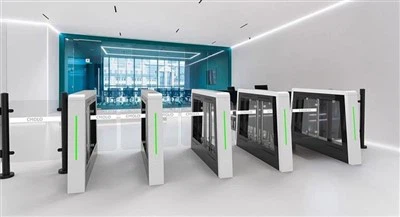
1, Definition of subway gate
Subway gate, also known as subway access control system or automatic ticket checking machine, is a channel management device designed based on electromagnetic and mechanical principles. It is usually installed at the entrance and exit of subway stations, used for identity verification, authorization, and traffic control of passengers entering and exiting. The subway gate integrates sensors, card readers, motors, controllers and other components to achieve automated and intelligent access control management functions, effectively improving the operational efficiency of subway stations and the travel experience of passengers.
2, Structure of subway gate
The structure of subway gate is complex and precise, mainly including the following key parts:
Chassis: As the main structure of the gate, the chassis is usually made of sturdy and durable metal materials, with functions such as waterproof, dustproof, and explosion-proof. The chassis integrates core components such as motors, controllers, and sensors, providing reliable support for the normal operation of the gate.
Door body: The door body is one of the core components of a gate, usually composed of multiple rotatable or translational blades (also known as gates). These blades are driven by a motor to open and close, thereby controlling the entry and exit of passengers. The design of the door not only requires a beautiful and elegant appearance, but also ensures the safety and comfort of passengers during the passage.
Sensors: Sensors are important components for intelligent management of turnstiles. It is usually installed on the front and rear sides of the door to detect the passage status and position information of passengers. When the sensor detects a passenger approaching, it will send a signal to the controller, triggering the opening action of the gate.
Card reader: The card reader is a key component for the gate to implement identity verification and authorization. It is usually installed on the side or top of the gate, used to read the credential information held by passengers such as subway cards, bus cards, QR codes, etc. The card reader verifies the identity and permissions of passengers through communication with the backend system, and determines whether to allow them to pass through the gate.
Controller: The controller is the "brain" of the gate, responsible for receiving signals from sensors, card readers, and other components, and processing them according to preset rules and algorithms. The controller sends control commands to the motor to achieve the opening and closing actions of the gate. At the same time, the controller also has functions such as fault alarm and self diagnosis to ensure the stable operation of the gate.
3, Working principle of subway gate
The working principle of subway turnstiles is based on the interdisciplinary application of electromagnetic induction, mechanical transmission, and intelligent control. Specifically, the workflow of the gate includes the following steps:
Identity verification: When a passenger approaches the gate, the card reader will read the credential information held by the passenger (such as subway card, QR code, etc.). These information are transmitted wirelessly to the backend system for authentication and permission determination.
Authorization Decision: The backend system decides whether to allow passengers to pass through the gate based on their identity information and permission level. If the verification is successful, the system will send an enable command to the controller; If the verification fails, the gate will remain closed and may issue an alarm signal.
Mechanical transmission: When the controller receives the opening command, it will start the motor to drive the door body to rotate or translate. The door gradually opens under the drive of the motor, forming a passage for passengers to pass through.
Traffic monitoring: During the process of passengers passing through the gate, sensors will continuously monitor the passengers' traffic status and location information. Once it is detected that the passenger has completely passed through the gate, the controller will immediately send a closing command to the motor to restore the door to its initial closed state.
Recording and statistics: The gate also has recording and statistics functions. It will record the time, number of people, and other information of each pass, and upload it to the backend system for data analysis and processing. These data are of great significance for subway companies to optimize their operational strategies and improve service quality.
4, The function and application of subway turnstiles
As an important component of urban rail transit systems, subway gates have multiple functions and application scenarios:
Controlling pedestrian flow: The subway gate effectively controls the density of pedestrian flow within the subway station by limiting the number of people and time intervals for each passage. This helps prevent safety accidents such as overcrowding and stampedes, ensuring the safety of passengers' travel.
Identity verification and authorization: The subway gate achieves passenger identity verification and authorization through communication with the backend system. This helps prevent unauthorized passengers from entering the subway station, ensuring the safety and order of the subway station.
Data recording and statistics: The subway gate will record the time, number of people, and other information of each passage, and upload it to the backend system for data analysis and processing. These data provide valuable operational data support for subway companies, helping to optimize operational strategies and improve service quality.
Intelligent management: With the continuous development of technologies such as the Internet of Things and big data, subway gates are gradually achieving intelligent management. For example, by introducing technologies such as facial recognition and fingerprint recognition, the accuracy and convenience of identity verification can be further improved; Through the networking management function, remote monitoring and fault alarm functions can be achieved, improving operation and maintenance efficiency and management level.
Widely used: Subway turnstiles are not only widely used at the entrances and exits of subway stations, but also gradually extended to other public transportation and public facilities. For example, subway gates also play an important role in places such as bus stops, airports, and train stations. In addition, with the continuous improvement and development of urban rail transit systems, subway turnstiles will also face more application scenarios and market demands.
https://www.cmolo.com/flap-barrier-turnstiles/motorized-flap-barrier-turnstile-cpw-229hs.html


WhatsApp : 0086-15999546575
Skype : cmolo.joy
Email : contact@cmolo.com
Tel : 0086-15999546575
CMOLO Industrial Park,NO. 144-1, Hengping Road,Henggang Street, Longgang District, Shenzhen City, China