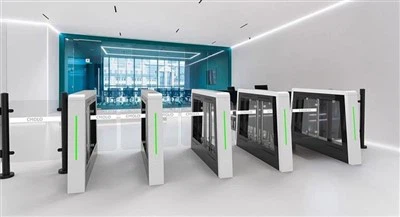
1. Security performance: Setting up more than one protective mechanism
Sports stadiums have substantially stricter safety rules than regular businesses. The safety design of turnstiles must encompass three dimensions: physical barriers, emergency response, and intelligent warning systems.
Protection from harm: Pick a full-height turnstile (height ≥ 2.2 meters) with three or four rows of turnstiles that are meant to make a closed passage. This will stop people from climbing or crossing the turnstiles, which are illegal. A full-height cross turnstile controls access via a 120° rotation angle in a huge sports hall. It has a stainless steel box and explosion-proof glass to safeguard people while still looking good.
Emergency system: When the gate is turned off, it should have an emergency stop button, an anti-pinch sensor, and a way to free itself automatically. If someone breaks in or the equipment stops working, the system should quickly lock the rotating pole, sound an alert, and send a message to security staff. For instance, during testing, a certain venue gate pretended that there was a power outage, and the rotating pole automatically reverted to a horizontal position within three seconds to make sure that the evacuation routes were clear.
Smart warning: using video analysis and infrared radiation sensors to keep an eye on how people act in real time in the channel. If the system finds objects that are trailing, stranded, or out of the ordinary, it will send alerts to management staff through both local alarms and push notifications to remote platforms.
2. Traffic efficiency: changed to fit the way tides flow
Most people attend sporting arenas 1-2 hours before the event starts, so the gates need to be able to respond quickly and let a lot of people through:
Recognition technology: Gates that can do multimodal recognition, like face recognition, QR code, and NFC card composite verification, should be given the most attention. The speed of recognition should be ≤ 0.3 seconds per individual. For instance, a given place has gates that use dynamic facial recognition. A single channel can handle 1200 people per hour at a concert with 5000 seats. This is 40% more than typical card swiping gates.
Designing the channel: The number of channels should be set based on the size of the venue. For the main entry, it is best to utilize "4 fast channels+2 slow channels" (4 fast channels+2 barrier-free channels). The rapid channels should be at least 900mm wide, and the barrier-free channels should be at least 1200mm wide. A dynamic diversion system at one Olympic site dynamically changes the amount of open lanes dependent on how many people are there at the time, cutting down on wait times during busy times to 5 minutes or less.
Anti-congestion mechanism: The gate should be able to tell when traffic is going the other way. It will lock the lever and play a voice prompt right away when it sees someone backing up. At the same time, anti-slip tiles should be put down on the passage floor with a slope of 5° or less. This will keep people from becoming stuck when it rains.
3. Environmental adaptability: Being able to handle difficult working situations and problems
The access to sports stadiums is complicated, and the gates must be waterproof, dustproof, corrosion-resistant, and anti-interference:
Protection level: The box body is composed of 304 stainless steel and the exterior gate must exceed the IP65 protection requirement. The anti-rust paint is sprayed on the surface of the revolving rod. During the rainy season test at a certain southern venue, the turnstiles kept working normally even after 72 hours of nonstop rain, and there were no short circuits in the internal circuits.
Northern venues need to pick gates that can work in temperatures from -30 to +60 degrees Celsius. The motor should also use low-temperature oil to make sure it starts up smoothly in cold weather. A Harbin venue tested the gate in a -25 °C environment and found that it only takes 1.2 seconds to go from standby to fully open, which is fast enough for quick transit.
Electromagnetic compatibility: The gate must pass the GB/T 17626.5 electromagnetic compatibility test to avoid problems with surrounding wireless devices (such walkie-talkies and WiFi routers) that could cause it to work incorrectly. Before installation, a given venue scanned the electromagnetic environment. By moving the gate antenna and changing the thickness of the shielding layer, the number of false alarms was cut to less than 0.1%.
4. Installation requirements: Make sure that the equipment works reliably.
The quality of the gate's installation has a direct effect on how long it lasts and how often it breaks, so the following measures must be performed exactly:
Basic treatment: Pour C25 concrete on the ground to a depth of at least 300 mm, and put M12 expansion bolts in place before the concrete sets. The gate of a certain venue shook after being open for three months because the foundation was weak. In the end, the foundation needs to be re-poured and strengthened, which will cost an extra 20,000 yuan.
Horizontal calibration: Use a laser level to make sure the gate is straight and level, with an inaccuracy of less than 1 mm/m. If the gate is slanted, it will make the rotating rod and the box rub against each other more, which will wear out the motor faster.
Wiring requirements: The power line uses RVV 3 × 2.5mm ² encased wire, the signal line uses RVVP 2 × 1.0mm ² shielded wire, and the cable is run through galvanized steel pipe so that it doesn't share the same conduit with heavy current lines. Because the signal and power lines were mixed up in a given place, the turnstiles had to be restarted often, and it took three days to fix the problem.
5. System integration: get full digital control of the whole process
It is important for ticketing systems, security platforms, and data analysis tools to work well with rotary turnstiles.
Ticket docking: allows QR code NFC and multimedia ticket verification, such as ID cards. It works with platforms like the Zhongding ticketing administration system to achieve "ticket gate integration" management. A certain venue has built an API interface that connects real-time gate access data to the ticketing system with a 99.99% accuracy rate for verification.
Linking security: Video surveillance and access control systems are connected to the gate. When an anomalous pathway is found, the camera images around it are promptly sent to the security terminal. During testing, a certain location set up a tailgating scene, and the system was able to finish the entire process of sounding the alarm, locating the image, and retrieving it in less than two seconds.
Analysis of data: Use gate traffic data to make heat maps and passenger flow trend reports that can help you improve the design of the venue's flow. For instance, one venue temporarily changed several gates to departure mode based on how many people were coming and going on Saturday afternoons. This made the evacuation process 30% faster.
6. Strategy for maintenance: Increase the life of your equipment
Regular maintenance can cut the number of turnstile failures by more than 40%. It is important to set up a system of "daily inspection, quarterly maintenance, and annual overhaul."
Check the lubrication of the rotating rod, the cleanliness of the sensors, and the condition of the fasteners every day, and keep track of the operational data. During an inspection, a specific venue found that the spinning rod bearings were worn out. They were able to avoid a huge problem by changing them ahead of time.
Every three months, you should clean the movement thoroughly, change the gearbox's lubricating oil, and check the motor's insulating resistance. While doing maintenance at a given location, it was found that the insulation on the motor winding had gotten worse. The equipment lasted two more years once it was fixed on time.
Managing spare parts: Set aside important spare parts such motors, encoders, and electromagnets so that they can start working again within four hours after a problem. A venue has set up a spare parts inventory alert system that starts the buying process automatically when the inventory of a given model of spare parts falls below 10%.
7. User Experience: Improve the design of traffic details
To make users happier, turnstiles should be designed with both safety and comfort in mind.
Accessibility: Create separate paths for individuals with impairments, pregnant women, and those carrying big things. These paths should be at least 1200mm wide and have voice prompts and low-level card readers. In a test of a given venue's barrier-free passage, disabled people were able to travel 50% faster than in regular passages.
Support for more than one language: For international contests, the interface display and voice prompts must be able to show and speak both Chinese and English. OTA has improved the gate of a certain Asian Games venue to offer Arabic language options, which will help more than 95% of the crowd.
Visual help: There are arrow light strips on the ground of the channel, and LED direction signs on the box to help people get through swiftly. The user mistake rate went down from 8% to 0.5% during the light strip test at a given place.
8. Cost control: Finding the right balance between performance and investment
When choosing turnstiles, you need to think about both the upfront cost and the long-term operational costs:
Choosing the right equipment: The price of a full-height rotary turnstile is between 20,000 and 50,000 yuan per unit, and the price of a three-roller turnstile is between 8,000 and 15,000 yuan per unit. For big places, it's best to use both "full height gates" and "three roller gates." Full height gates should be at the main entrance to keep people safe, while three roller gates should be at the secondary entry to keep costs down.
Improving energy use: Pick a gate that has a sleep mode that puts it in a low-power condition when no one is passing through. One place has started managing its energy use, which has saved 300 kWh of energy per gate each year and cut its electricity expenditures by 40%.
The full lifecycle cost is the overall cost of buying, setting up, fixing, and upgrading computer hardware. When comparing a given venue, it was determined that choosing high-quality mid- to high-end turnstiles costs 15% less over five years than choosing low-end items, even though the initial cost is 20% higher.


WhatsApp : 0086-15999546575
Skype : cmolo.joy
Email : contact@cmolo.com
Tel : 0086-15999546575
CMOLO Industrial Park,NO. 144-1, Hengping Road,Henggang Street, Longgang District, Shenzhen City, China