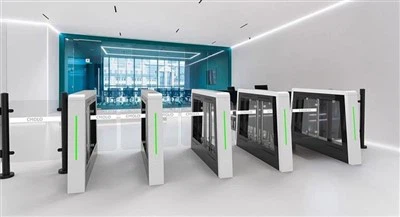
1. Mechanical structure: a safety system that is both hard and flexible
The physical structure of a turnstile is what keeps it safe. It needs to be able to resist impact, drilling, and be comfortable to use. Most of the time, the products on the market today have full-height stainless steel enclosures made of 304 or 316 stainless steel. The surface is brushed or mirror-treated, which not only meets the IP45 dust and waterproof standards, but also protects against very corrosive environments. For instance, the box of the prison-specific full-height turnstile can be 3mm thick, and when it is bolted down with bottom expansion bolts, it can take a lateral impact force of 1000kg.
The blocking body is the most important part of the mechanical construction, and how it is made has a direct impact on how well it stops tailgating. Frontier goods generally include a double-wing rotating door structure. The door wings are made of tempered glass panels and a 304 stainless steel frame. The glass is 8mm thick, which makes it clear and keeps it from breaking violently. The door wing can only turn between 90 and 120 degrees, and it has a 15-degree anti-reverse mechanism that stops reverse entry. Some high-end models also have hydraulic shock absorption systems. These systems use hydraulic buffering to keep the door wings from moving too much when they open and close, and they make less noise than 55dB, which is quiet enough for places like libraries and hospitals.
2. Power System: Smart Control and Precision Transmission
The rotary gate's power system needs to work for a long time with high precision and minimal energy use. The key to this is the collaborative design of the motor and gearbox mechanism. The most common alternative right now is to utilise brushless DC motors (BLDC). These motors are 30% more efficient than standard brushed motors, last over 50,000 hours, and don't need carbon brushes replaced often, which cuts maintenance expenses by 60%. For instance, a certain brand's SA101 series turnstiles include a brushless DC motor that runs on 48V and has a rated power of only 120W. This motor can move a 250kg door wing through a 90° rotation in 2 seconds.
The combination of planetary reducers and synchronous pulleys has become the most common way to transmit power. The planetary reducer uses multi-stage gear meshing to provide a lot of torque, and the synchronous belt pulley makes sure that the gearbox is accurate and silent. Some devices additionally come with torque sensors built in. If the door wings run into something that shouldn't be there (such a person being stuck), the motor can immediately reverse to remove pressure and keep people safe. For instance, the torque limit for one kind of turnstile is 15N · m. The door wing will bounce back to its starting position in less than 0.5 seconds if the resistance is higher than this figure.
3. Control module: edge computing and multi-mode perception
Technological advances in the control module are what make the smart update of rotating turnstiles possible. The ARM Cortex-M7 CPU and the RTOS real-time operating system are the primary parts of most current products. These two systems may work on sensor data, check permissions, drive motors, and do other activities at the same time. For instance, the control board of a certain brand's turnstile has 16 digital input/output interfaces built in. This makes it easy for access control systems, fire prevention systems, and monitoring systems to work together.
Multimodal sensor arrays are now standard at the perception layer. Infrared sensors can tell if there are people walking by with an accuracy of up to 20mm and can tell if someone is following someone else. Millimetre wave radar can keep an eye on things that are in the way of the door wing's movement with a response time of less than 100ms. Pressure sensors are built into the bottom of the door wing and can feel the force of a person's steps to help figure out which way they are going. Some high-end models also have 3D structured light cameras that use point cloud data to recreate the shapes of people walking by. This lets them recognise people in real time and verify their identities.
4. Intelligent interaction: smooth transit and scene adaptability
The interactive design of modern turnstiles is changing from "passive response" to "active service." It supports non-contact IC cards, QR codes, and NFC as ways to verify identity. A combination of different types of recognition, such as facial recognition, fingerprint recognition, and palm vein recognition, among others. For instance, the facial recognition module on one type of turnstile uses binocular cameras and near-infrared fill lights to recognise people with 99.5% accuracy in difficult situations including bright light, backlight, and masks. The turnstile can let people through in 0.3 seconds.
The automatic unlocking feature after a power breakdown has become common for emergency management. The built-in battery can keep the gate working for two hours when the main power goes off, and the electromagnetic lock will open on its own. To suit the needs of fire evacuation, the door wings can be pushed open by hand. Some products also let you control and maintain them from a distance. They do this by sending real-time data like device status, fault codes, and traffic logs to the cloud over 4G/5G modules. More than 80% of downtime can be avoided by having operation and maintenance staff diagnose and fix problems from afar.
5. Industry Trend: Moving from single devices to system solutions
As smart city building moves forward, turnstiles are changing from separate devices to parts of a larger system. For instance, in the smart park scenario, turnstiles can be connected to systems that recognise license plates, manage visitors, and regulate lifts to gain full control over "people vehicle objects." In the tube scenario, the turnstile can have a temperature detection module built in so that people can be screened for health without touching anything during the epidemic. The turnstile in the scenic area can be connected to the electronic ticketing system, which allows for many ways to get in, like QR codes, ID cards, and facial recognition. This makes the experience better for visitors.
Also, modular design is becoming more popular in the business world. Manufacturers may swiftly make changes to products based on what customers want by separating the mechanical structure, power system, and control module into separate parts. For instance, the box body, door wings, motor, and control board of a certain brand's turnstile all have common interfaces. Users can mix and match modules of different materials, colours, and functionalities to meet their specific needs for "thousands of machines and faces."
Stadium Turnstiles


WhatsApp : 0086-15999546575
Skype : cmolo.joy
Email : contact@cmolo.com
Tel : 0086-15999546575
CMOLO Industrial Park,NO. 144-1, Hengping Road,Henggang Street, Longgang District, Shenzhen City, China