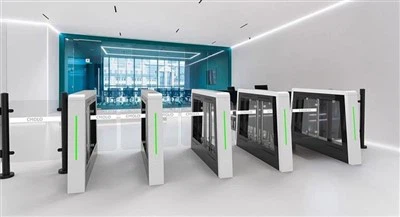
The most usual mechanical failure of rotary turnstiles is loose joint screws. The double headed screw's positive and negative thread configuration might lead to long-term vibration causing upper and lower bearings to vary in position. According to the recorded data of a certain subway station, such flaws account for 28%; the usual manifestation is still a 2-3mm displacement following the gate is in place. Special tools should be used to change the double headed screw during maintenance such that the brake rod's placement precision is ≤ 0.5mm.
Unnecessary brake lever shaking on the connecting arm will result from loose screws there. Three accidents of gripping individuals every month resulted from a vertical deviation of 8 ° in the brake rod caused by a nut not tightened in a specific manufacturing application situation. The maintenance criterion calls for fastening using a torque wrench with a torque value of 35N · m ± 5%.
Full height rotary brakes especially show the breakdown of hydraulic shock absorbers as rather noticeable. Data from a jail project show that the damping coefficient of the shock absorber dropped by 60% after two years of use, therefore lowering the reset time to 0.3 seconds (typical value 0.8-1.2 seconds) and generating a strong impact sound. Check the shock absorber oil pressure often; replace it right away should the pressure measurement be less than 0.8MPa.
The Hall element's detecting precision will suffer from the magnet's displacement in situ. The magnet in a case of a gate machine in a particular picturesque area was misaligned by 3mm, producing a 15 ° misalignment of the gate rod. Recalibrating the magnet's position will help to guarantee that the distance between it and the reducer's cam disc stays 2 ± 0.2mm.
Direct damage to the electromagnet influences the brake lever's locking mechanism. According to actual test data, an atmosphere of -20 ℃ reduces the suction force of inferior electromagnets by 40%, which causes an unintended gate opening at a certain northern station. Industrial quality electromagnets ranging in operational temperature from -40 ℃ to +80 ℃ are advised to be used.
Program anomalies are common manifestations of control motherboard failures. The primary program's leaving caused the gate of a certain office building to fall, and recovery takes 45 minutes. Setting up a watchdog circuit, automatically restarting when the program is aberrant, and monthly firmware version updates constitute part of preventive actions.
False alarms mostly result from the failure of infrared radiation. Real measurements taken at an airport indicate that a 5 ° difference between the transmitting and receiving ends can lead to 30% of occlusion misjudgments. Regular cleaning of the optical lenses and a laser calibrator help to guarantee the aiming angle's accuracy is < 0.1 °.
Vehicle detection will suffer depending on loose ground sensing coils. In a situation involving a logistics park, the coil was not firmly attached, leading to an 18% misjudging rate when trucks passed. Epoxy resin sealing technology should be applied under maintenance to guarantee that the bonding strength between the coil and the road surface is > 5MPa.
Electrostatic damage usually causes card reader failures. The annual failure rate is as high as 12 times per unit as a certain production gate lacks ESD protection fitted. Lay anti-static grounding pads and employ industrial grade card readers including TVS diodes.
maintenance system: Every day clean the movement; check the tightness of screws; apply specialist lubricating grease every week; do monthly alignment tests of transmission components.
Monitoring Vibration: Install acceleration sensors at important bearings to set off alarms should the vibration value be more than 5g.
Establish a basic component life ledger, advise necessary replacement of hydraulic shock absorbers inside two years, and replace electromagnets inside three years.
Adopting a dual circuit power supply+UPS solution would help to guarantee that it can run for 30 minutes even after a power outage.
The equipment has to satisfy the GB/T 17626.2-2018 electrostatic discharge immunity level 4 certification.
Grounding system: The separation distance between signal grounding and power grounding should be > 5 m; the protective grounding resistance should be < 4 Ω.
Starting self calibration when the signal intensity decreases by 20%, intelligent calibration system is coupled with automatic alignment method.
Environmental compensation technology: infrared sensor detection accuracy maintained within the range of -30 ℃~+70 ℃ by use of a temperature compensation circuit
Dual card readers are set for important channels, which automatically switch within 0.5 seconds upon primary card reader failure.


WhatsApp : 0086-15999546575
Skype : cmolo.joy
Email : contact@cmolo.com
Tel : 0086-15999546575
CMOLO Industrial Park,NO. 144-1, Hengping Road,Henggang Street, Longgang District, Shenzhen City, China