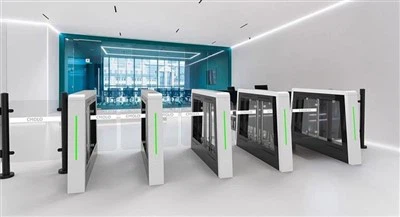
Industry figures suggest that the general failure rate of turnstiles is constant at roughly 2%, so an average of 2 out of every 100 devices may show irregularities. The forms of faults show an "80/20 distribution":
Hardware failures account for 80%, mostly in mechanical components such as motors, sensors, reducers, etc., such as encoder accuracy attenuation leading to door positioning deviation and infrared sensor false triggering creating pinch alarms.
Twenty percent of software faults have to do with system compatibility, network connection protocols, and data processing modules-that is, problems between access control systems and interfaces for validating health codes.
The daily traffic volume of subway station gates surpasses 100,000 persons, and their failure rate is three to four times higher than that of office building equipment having a daily traffic volume of 5,000 people.
Environmental adaptation difficulty:
High humidity and temperature scenario: The three-proof paint coating systems have to be reinforced since the annual failure rate of circuit boards in subway station gates in southern China is 25% greater than that in dry conditions in northern China.
Salt spray corrodes equipment in coastal settings, so stainless steel shells have a corrosion rate of 0.02 mm/year. Regular rust inhibitor spraying or 316L material is thus necessary.
The effect of maintenance quality: Compared to normal maintenance equipment, equipment without monthly deep maintenance has a 50% faster motor bearing wear rate and a 1.8-fold increase in failure rate.
Mainstream manufacturers set a three-level maintenance scheme based on fault prevention theory and equipment life curve:
Everyday Inspection: Daily
Infrared alignment calibration: Find the sensitivity of the transmitting/receiving end using a typical shielding plate; if the deviation is more than 5%, change the optical axis.
Mechanical damping test: When manually pushing the door body, the resistance should be ≤ 15 N. If there are any abnormalities, the lubrication status of the bearings should be checked.
Monthly deep maintenance:
Circuit board dust removal: Use anti-static brushes to clear the dust accumulation on the control motherboard, with an emphasis on cleaning the DC24V power module heat sink.
Lubrication of the transmission system: Add lithium-based grease to the planetary reducer gear set, with the oil injection amount controlled at 1/3 of the gear chamber volume.
Preventive maintenance for quarters:
Tests of motor performance: measuring the driving current's waveform with an oscilloscope If the harmonic content exceeds 8%, it is necessary to replace the driving module.
Simulate a power loss situation, confirm the UPS battery life is > 15 minutes, and check the manual release mechanism operation force is < 50 N.
Extreme plan for enhancement of the surroundings:
Areas of northern cold, below -20°C: The motor is fitted with a heating film, and low-temperature grease is utilized at -40°C. The preheating time is now three minutes before starting.
Southern humid and hot areas: widen the heat sink fin spacing to 3mm, add thermal conductive silicone pads to circuit boards, and improve air convection.
High-load scenario optimization:
Hub stations for subway: Every 500,000 passes, execute dynamic balance checks on the doors using laser rangefinders to identify opening and closing trajectory deviations of ≤ 2mm.
Big venues: After every event, check the swing arm hinge wear and replace the nylon lining should the gap be more than 0.5mm.
For instance, using factual information from a particular subway line:
The annual maintenance cost dropped from 120000 yuan/station to 45000 yuan/station, a 62.5% drop following quarterly preventative maintenance.
With an availability rate of 99.2%, the MTBF of the equipment has climbed from 1800 hours to 3200 hours.
System of Predictive Maintenance: A warning is set off when the vibration intensity exceeds 4.5 mm/s by tracking motor bearings using vibration sensors, therefore advancing the defect detection time by 72 hours.
Build 3D models of tools, replicate stress distribution under various operating environments, and maximize maintenance cycle settings using digital twin technology.
Face Recognition Fingerprint Airport Turnstile


WhatsApp : 0086-15999546575
Skype : cmolo.joy
Email : contact@cmolo.com
Tel : 0086-15999546575
CMOLO Industrial Park,NO. 144-1, Hengping Road,Henggang Street, Longgang District, Shenzhen City, China